


[Note: This article is for educational purposes only and is not intended as medical advice. If you are experiencing symptoms of postpartum depression or need support, please consult a qualified healthcare professional.]
Motherhood is supposed to be one of the happiest times in life. So what happens when it doesn’t feel that way?

Postpartum depression affects millions of women, yet it is often misunderstood as simply stress, exhaustion, or hormonal changes. In reality, the postpartum period is one of the biggest biological and neurological transitions the human brain will ever undergo.
To explore the science behind PPD, I’m joined by Judy Dippel, author of Breaking the Grip of Postpartum Depression. Through her own experience with postpartum depression and years of advocacy, Judy has helped bring awareness to a condition that too many women suffer through in silence. Her book is available on Amazon.
In this article, Judy shares her personal story and the realities of postpartum depression. Then we’ll dive into the neuroscience: how hormones, stress, inflammation, and brain circuits involved in motivation and emotion may contribute to PPD, and what recovery can look like from a brain-health perspective.
Because understanding what’s happening in the brain can help replace confusion and guilt with knowledge, compassion, and hope.
Judy’s Story: When Being a Mother Doesn’t Feel Like You Expect
I had never been depressed, nor did I have any history of mental disorders. All I knew was that without warning, at 32-weeks gestation, I woke up one morning (after a bout of the flu) and felt totally foreign and peculiar; I felt distant and removed from reality and who I knew myself to be. I looked at myself in the mirror and thought, “Who is this person?” I felt outside myself, as if I was a mere observer—as if an unwanted metamorphosis had taken place.
With the usual light of the morning sun, I would wake up, and for a brief moment feel normal, but once I was fully awake an odd darkness and doom penetrated and surrounded me. I felt invaded by intrusive and frightening thoughts. These phobias nearly suffocated all good sense as they numbed me to my true perception of myself and the world around me—the familiar and comfortable had been stripped from me, literally overnight.
As I walked through the fog and fear it created within me, I kept it all a secret, thinking that once I delivered my baby, my hormones would return me to normal. I felt embarrassed to admit the anxiety and phobias that left me feeling—I had gone crazy!
Once I did deliver, what I now know was clinical postpartum depression, anxiety and obsessive-compulsive disorder—only got worse. And along with that, I had an array of physical symptoms that doctors gave me prescriptions for, but no answer as to why I was no longer me.
Nearly two years later, I learned that hypoglycemia was a major contributor to my ongoing physical symptoms. After making significant, high-protein dietary changes, my physical symptoms improved, and I began feeling more like myself again.
To find the full story, grab a copy of Breaking the Grip of Postpartum Depression on Amazon or learn more in my Substack “Postpartum Sanctuary” series, where comments and questions are welcome.
Postpartum Depression Is More Complex Than Many Realize
Clinical postpartum depression and/or accompanying perinatal mood disorders cause intense suffering and distress among 11-20% of new mothers.
These conditions are far more common than many people realize! And despite how common they are, many women suffer in silence.
Postpartum Depression and accompanying Perinatal Mood Disorders can affect a woman who:
· is currently pregnant
· has recently delivered her baby
· has ended a pregnancy or has experienced a miscarriage
· has stopped breastfeeding
Postpartum depression is rarely a stand alone diagnosis, but instead have the following defined perinatal mood disorders. Statistics on Perinatal Mood Disorders that can accompany postpartum depression show the following:
Anxiety: An estimated 8.5% to 11% of pregnant women will experience moderate to severe symptoms of anxiety or a mixture of anxiety and depression. (e.g. Hot sweats, dizzy, fearful, shaky, can’t concentrate.)
Postpartum Obsessive-Compulsive Disorder: this occurs in approximately 3% to 5% of new mothers, yet it can be the most alarming. (e.g. Intrusive and persistent thoughts or mental images and a sense of fear or horror about the thoughts/images.)
Postpartum Traumatic Stress Disorder: An estimated 1% to 6% percent of women will experience the onset of postpartum traumatic stress disorder. (e.g. Trauma re-experienced through dreams, or thoughts. Avoidance of stimuli associated with the event; thoughts, feelings, people, places; hyper vigilance.)
Postpartum Bipolar Disorder: Bipolar Disorder is a category of mood disorders defined by the presence of one or more episodes of elevated mood/mania and depression present at the same time.
Postpartum Psychosis: This is rare! Occasionally a woman may have a more severe postpartum disorder which is known as postpartum psychosis. There is a 5% suicide and a 4% infanticide rate associated with psychosis. It affects only 0.1% to 0.2% of mothers. That is 2 mothers of every 1000 babies born. Immediate treatment is imperative (Gaynes, et al., 2005).
It is important to note that Postpartum Depression and Perinatal Mood Disorders are not to be confused with the common “Baby Blues” that 80 percent of mothers experience. Baby Blues are an altogether expected response to the hormonal shift that pregnancy, birth and nursing create. Short-lived, it usually lasts 2-3 weeks.
Judy’s story highlights that postpartum depression involves changes across multiple biological systems, including the brain, hormones, immune system, and stress-response networks. To understand why postpartum depression develops, we first need to understand what happens inside the postpartum brain.

Changes in the brain during pregnancy/postpartum
Pregnancy is one of the most significant periods of brain remodeling in adult life.
Neuroimaging studies have identified changes in brain regions involved in social cognition, emotional processing, and maternal behavior. Researchers believe these adaptations help mothers become more responsive to infant cues and support caregiving behaviors after birth.
In many ways, the brain is preparing for a completely new role.
The postpartum period adds another layer of complexity. The brain must adapt to major physiological shifts, fragmented sleep, new routines, and the constant demands of caring for a newborn. While these changes are often adaptive, they also create a period of increased vulnerability to mood disorders, including postpartum depression.
What Neuroscientists Know:
• Pregnancy is associated with measurable changes in brain structure.
• Brain regions involved in caregiving become more responsive to infant-related cues.
• The postpartum period requires continued neurological adaptation.
• Significant biological transitions can increase vulnerability to mood disorders in some individuals.
Hormone roller coaster
Few biological events involve hormonal changes as large as during pregnancy and childbirth.
Throughout pregnancy, estrogen and progesterone rise to levels far beyond those seen during a typical menstrual cycle. Following delivery, both hormones decline rapidly within a matter of days.
These hormones influence several neurotransmitter systems involved in mood regulation, including serotonin, dopamine, and GABA. One molecule that has received particular attention is allopregnanolone, a metabolite of progesterone that helps regulate activity within the brain’s inhibitory networks.
For some women, the brain appears particularly sensitive to these hormonal fluctuations. Research suggests that rapid shifts in reproductive hormones may alter neural activity in ways that increase susceptibility to depressive symptoms.
Scientists are still working to understand why some women develop postpartum depression while others do not. Hormonal sensitivity is increasingly viewed as one important piece of the puzzle.
Key Biological Players
• Estrogen influences serotonin and dopamine signaling.
• Progesterone affects mood through several neural pathways.
• Allopregnanolone interacts with GABA receptors involved in stress regulation.
• Individual differences in hormone sensitivity may influence risk.
Stress response and emotional overload
The postpartum brain is not only responding to hormonal changes. It is also adapting to one of the most demanding periods of life.
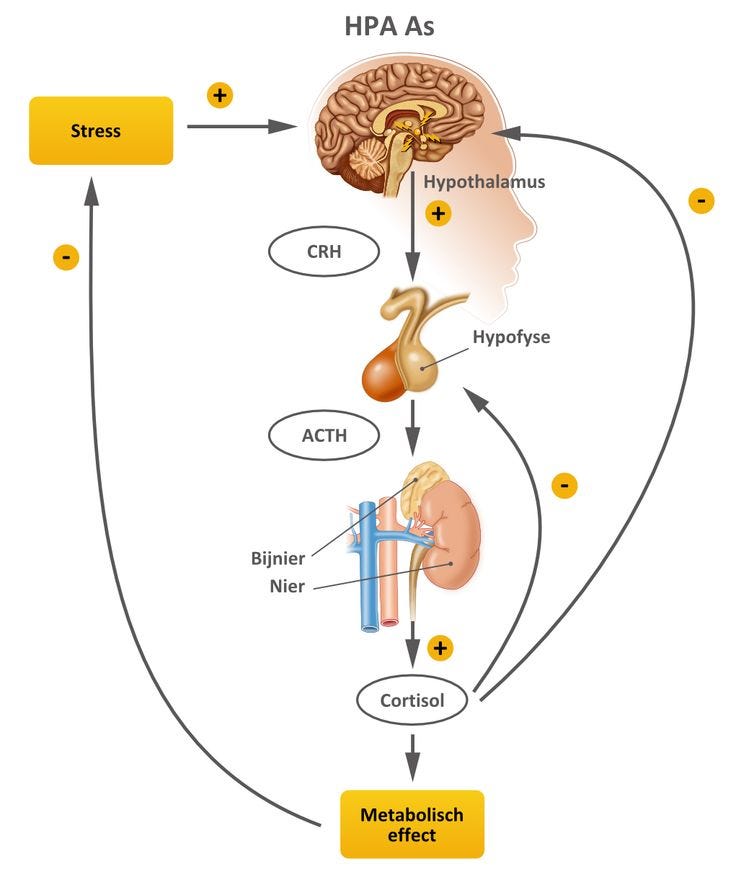
Pregnancy alters the hypothalamic-pituitary-adrenal (HPA) axis, the body’s primary stress-response system. After birth, this system must recalibrate while mothers are often navigating sleep deprivation, physical recovery, and the responsibilities of caring for an infant.
Sleep loss alone can significantly affect brain function. Studies show that insufficient sleep can increase activity in the amygdala, a region involved in emotional processing, while reducing regulation from the prefrontal cortex, which helps manage emotional responses and decision-making.
The result can be heightened emotional reactivity, increased anxiety, difficulty concentrating, and a reduced ability to cope with stress.
For many women, postpartum depression develops within this complex intersection of biological changes and environmental demands.
What Neuroscientists Know
Pregnancy alters the HPA-axis.
Sleep deprivation increases amygdala activity.
The prefrontal cortex becomes less effective under chronic stress.
Stress and sleep disruption may amplify vulnerability to PPD.
Motivation & Joy circuit
One of the defining symptoms of postpartum depression is anhedonia, or a reduced ability to experience pleasure.
Many women describe feeling disconnected from activities they once enjoyed. Hobbies, social interactions, and even meaningful life events may feel emotionally muted.
Neuroscience points to the brain’s reward network, a system responsible for motivation, reward anticipation, and pleasure. This network relies heavily on dopamine signaling and includes regions such as the ventral striatum, nucleus accumbens, and prefrontal cortex.
Research suggests that women with postpartum depression may show altered activity within these reward circuits. As a result, experiences that would typically feel rewarding may produce a weaker neural response.
This may help explain why postpartum depression can affect not only mood, but also motivation, energy, and the capacity to experience joy.
The Reward Network
Dopamine helps drive motivation and pleasure.
The ventral striatum is involved in reward processing.
Altered reward signaling has been observed in PPD.
Reduced reward sensitivity may contribute to anhedonia.
Neuroinflammation
The immune system and the brain are in constant communication.
Pregnancy and childbirth require substantial immune adaptations, and the postpartum period involves inflammatory processes that support healing and recovery. Researchers are increasingly investigating how these immune changes may influence mental health.
One area of interest involves cytokines, signaling molecules that help coordinate immune responses. Elevated levels of certain cytokines have been associated with depressive symptoms in both postpartum and non-postpartum populations.
These molecules can influence neurotransmitter production, neural communication, and brain regions involved in mood regulation.
Although researchers are still working to understand the precise mechanisms involved, growing evidence suggests that inflammation may represent one biological pathway contributing to postpartum depression.
Inflammatory Markers Under Investigation
• Interleukin-6 (IL-6): Higher levels of IL-6 have been associated with increased depressive symptoms in some postpartum populations. Researchers believe IL-6 may influence mood by affecting neurotransmitter function and stress-response pathways.
• Tumor necrosis factor-alpha (TNF-α): TNF-α is a pro-inflammatory cytokine that can alter communication between brain cells and has been linked to depression in several studies, including research on postpartum depression.
• C-reactive protein (CRP): CRP is a marker of systemic inflammation. Elevated CRP levels have been observed in some women with postpartum depressive symptoms, suggesting a possible relationship between whole-body inflammation and mood.
• Other cytokines involved in immune signaling: Researchers continue to investigate how immune molecules influence brain function, emotional regulation, and neurotransmitter systems during the postpartum period.
No single inflammatory marker causes postpartum depression. But scientists believe inflammation may be one of several biological pathways that contribute to risk in susceptible individuals, and there is research being done right now on these.
Risk Factors
Postpartum depression does not have a single cause.
Current evidence suggests it emerges from the interaction of biological, psychological, and social factors.
A personal or family history of depression, anxiety disorders, hormonal sensitivity, sleep disruption, and chronic stress may increase vulnerability. Previous trauma, difficult pregnancies, birth complications, and limited social support can also contribute.
Researchers often describe postpartum depression through a biopsychosocial framework because no single factor fully explains who develops the condition.
Biological
• Personal history of depression
• Family history of mood disorders
• Hormonal sensitivity
• Sleep disruption
Psychological
• Anxiety
• Chronic stress
• Previous trauma
• Perfectionistic tendencies
Social
• Limited support systems
• Relationship difficulties
• Financial stress
• Social isolation
Brain recovery
One of the most encouraging findings in modern neuroscience is that the adult brain remains highly adaptable.
This capacity, known as neuroplasticity, allows neural circuits to reorganize in response to experience, treatment, and environmental change.
Research shows that psychotherapy, medication, physical activity, social support, improved sleep, and other evidence-based interventions can influence brain systems involved in mood regulation. Scientists are also investigating treatments that target hormonal pathways, inflammation, and stress physiology.
Recovery reflects changes occurring across interconnected systems involving the brain, endocrine system, immune system, and nervous system.
The same biological systems that support adaptation during pregnancy and motherhood also contribute to the brain’s capacity for recovery.
Actionable Steps for Moms
Postpartum depression exists alongside major biological and environmental demands on the brain. Small, consistent supports can make a measurable difference.
Prioritize Sleep: Sleep regulates mood and stress systems. Rest when possible, even in short blocks.
Ask for Help Early: PPD is a medical condition. Support can include therapy, family, or medical care.
Move Your Body: Light movement supports dopamine and serotonin systems. Even short walks matter.
Stay Connected: Social contact reduces stress load and isolation.
Reduce Perfection Pressure: Lower expectations during recovery and adjustment.
Support Basic Nutrition: Regular meals and hydration support brain function.
Notice Symptoms Early: Mood changes, anxiety, or disconnection are important signals.

Actionable Steps for Families
Family support can reduce stress load and improve recovery conditions.
Learn About PPD: Understand it as a brain-body condition, not behavior.
Watch for Changes: Track mood, sleep, withdrawal, and anxiety.
Offer Practical Help: Meals, chores, childcare.
Protect Sleep: Help create blocks of uninterrupted rest.
Listen First: Being present often helps more than trying to fix everything.
Encourage Care: Support therapy or medical visits.
Support Yourself Too: Caregivers need rest and support as well.
Postpartum depression is a complex condition shaped by changes in the brain, hormones, immune system, and environment. While the experience can feel isolating, understanding the science helps transform confusion into knowledge and self-blame into self-compassion. The more we learn about the postpartum brain, the better equipped we become to support mothers through one of life’s most significant transitions
Although many questions remain, neuroscience is helping us better understand why some women are more vulnerable during the postpartum period and which biological pathways may support recovery. Each new discovery brings us closer to more effective prevention, treatment, and support.
We hope you enjoyed this article.
Sending you all the love,
Judy Dippel
Dr. Reeders
Selected references
Postpartum Support International (PSI). (2026, May 13). https://postpartum.net/
Gaynes, B. N., Gavin, N., Meltzer-Brody, S., Lohr, K. N., Swinson, T., Gartlehner, G., Brody, S., & Miller, W. C. (2005). Perinatal depression: prevalence, screening accuracy, and screening outcomes. Evidence report/technology assessment (Summary), (119), 1–8. https://doi.org/10.1037/e439372005-001
Glynn, L. M., & Baram, T. Z. (2019). The influence of unpredictable, fragmented parental signals on the developing brain. Frontiers in neuroendocrinology, 53, 100736. https://doi.org/10.1016/j.yfrne.2019.01.002
Hoekzema, E., Barba-Müller, E., Pozzobon, C., Picado, M., Lucco, F., García-García, D., Soliva, J. C., Tobeña, A., Desco, M., Crone, E. A., Ballesteros, A., Carmona, S., & Vilarroya, O. (2017). Pregnancy leads to long-lasting changes in human brain structure. Nature neuroscience, 20(2), 287–296. https://doi.org/10.1038/nn.4458
Payne, J. L., & Maguire, J. (2019). Pathophysiological mechanisms implicated in postpartum depression. Frontiers in neuroendocrinology, 52, 165–180. https://doi.org/10.1016/j.yfrne.2018.12.001
Stewart, D. E., & Vigod, S. N. (2019). Postpartum Depression: Pathophysiology, Treatment, and Emerging Therapeutics. Annual review of medicine, 70, 183–196. https://doi.org/10.1146/annurev-med-041217-011106
Tebeka, S., Le Strat, Y., De Premorel Higgons, A., Benachi, A., Dommergues, M., Kayem, G., Lepercq, J., Luton, D., Mandelbrot, L., Ville, Y., Ramoz, N., Tezenas du Montcel, S., IGEDEPP Groups, Mullaert, J., & Dubertret, C. (2021). Prevalence and incidence of postpartum depression and environmental factors: The IGEDEPP cohort. Journal of psychiatric research, 138, 366–374. https://doi.org/10.1016/j.jpsychires.2021.04.004
Yim, I. S., Tanner Stapleton, L. R., Guardino, C. M., Hahn-Holbrook, J., & Dunkel Schetter, C. (2015). Biological and psychosocial predictors of postpartum depression: systematic review and call for integration. Annual review of clinical psychology, 11, 99–137. https://doi.org/10.1146/annurev-clinpsy-101414-020426
You did not mention the findings of increased levesl of Caseomorphines in lactating mothers with psot partum psychiatric reactions. https://pubmed.ncbi.nlm.nih.gov/6087690/ - In Norway they say : The mothers milk hvae gone to her brain ! https://www.lunduniversity.lu.se/lup/publication/fb4436ee-88ec-45b0-952c-0523dd0d31d4
This article is very timely for my wife as she just gave birth less than 2 weeks ago. Thanks for explaining this so thoroughly and, more importantly, for the useful takeaways.